Kingdom Maker: Build & Battle
- 4.2
- Rating
- 1.00M
- Installs
- Free
- Price

 Analysis by App-foxy
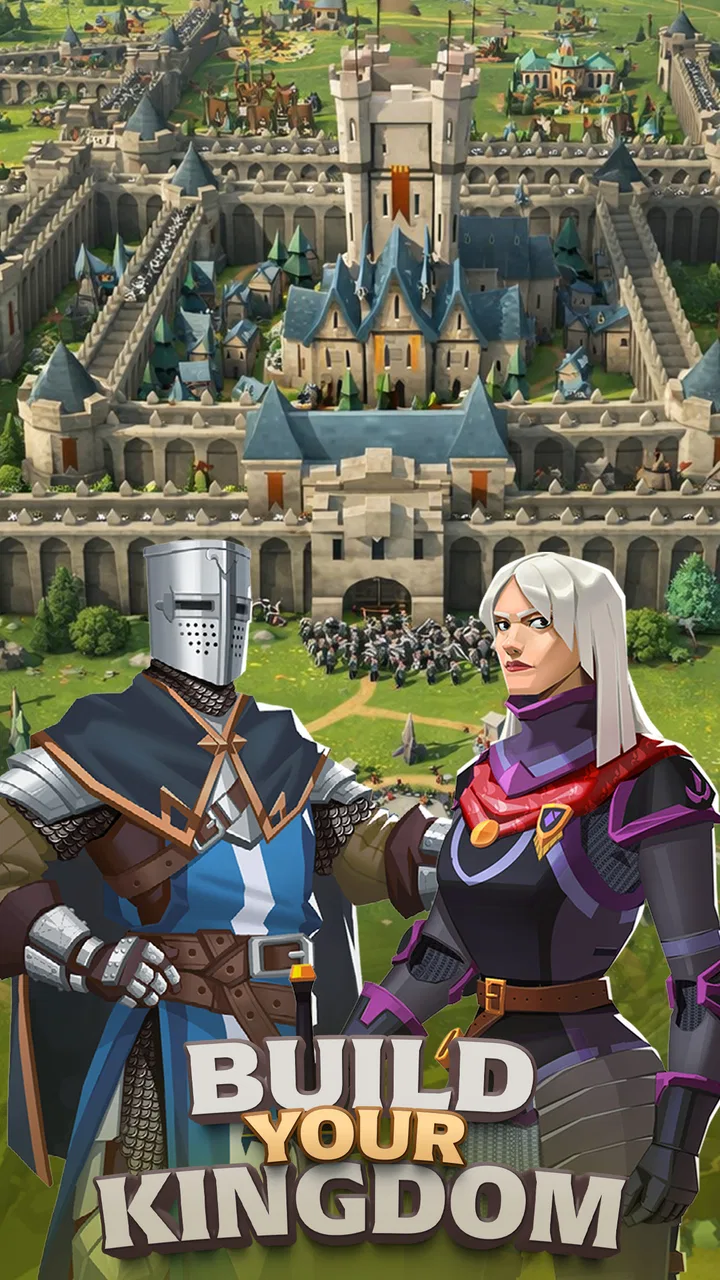
I approached Kingdom Maker: Build & Battle as a game to dip into during spare moments, but it quickly showed that it works best when I treat it as an ongoing medieval strategy project. I build up a kingdom, prepare forces, train dragons, and make decisions around battles and expansion. That combination gives it more personality than a simple castle-building game, while still keeping the basic goal easy to understand: develop a realm that can survive conflict and grow stronger.
It is a free strategy game from Global Worldwide, available for Android devices running at least Android 7.0. The game has been around since January 13, 2022, and its current version is 48.2.30. With over a million installs and an average rating of 4.2 from roughly thirty-nine thousand ratings, it has clearly found an audience. I can see why, although I also think the game asks for more patience and attention than its cheerful medieval presentation first suggests.
How it works when a household shares the device
The most natural shared-device scenario is a household where one person enjoys planning and another likes checking progress, looking at the kingdom, or taking part in the more dramatic battle moments. The game is easy to show someone because its central ideas are visible: a developing realm, armies to command, castles to conquer, and dragons that add a memorable fantasy layer. It does not require a reader to understand a complicated fictional universe before starting.
You May Also Like

 Blood Strike: 2.5 Anniversary
Blood Strike’s Loadouts Turn Every Drop Into a Tactical Gamble
A close look at Blood Strike’s custom loadouts: how fast access to signature weapons reshapes its battle royale rhythm, rewards preparation, and narrows the gap between fights.

 Pandora - Music & Podcasts
Pandora’s Music Is Easy to Start, but Harder to Recover
Pandora’s strength is its low-effort path from a seed to a station. Its weak spot is how much confidence it asks you to place in connection, setup, and quiet recovery.

 8 Ball Pool
 Is Built on Rivalries, Rematches, and Routine
A close look at the rivalries, rematches, shared routines, and unanswered safety questions that turn a quick pool match into a persistent mobile community.

 Samsung Music
’s Quiet Strength Is Playing What You Already Own
Its reach comes less from spectacle than from dependable access to a personal library. That simplicity is both the app’s strongest retention engine and its ceiling.

 AccuWeather: Weather Radar
AccuWeather Review: A Quick, Clear Forecast for Everyday Decisions
For everyday plans, the best forecast is the one you can understand quickly. AccuWeather makes rain timing, radar, and local conditions easy to act on, with a few trade-offs.

 Hill Climb Racing
Why Hill Climb Racing Still Turns Crashes Into One More Run
A tiny car, a bumpy hill and one more upgrade: Hill Climb Racing keeps resurfacing because its simple chaos makes every near-miss feel personal.
More From Our News Desk



That said, I would not treat it like a quick pass-and-play board game. The kingdom is a personal project, and decisions made by one player can affect what the next person sees. If two people use the same device, I would agree in advance on who is responsible for strategic choices. Otherwise, one person may spend time arranging the realm while another changes the direction of the army without realizing it.
This is especially relevant on a family tablet or a phone passed between siblings. A younger player might enjoy training dragons or launching into a battle, while an older player may care more about resource decisions and long-term development. Those interests can coexist, but only if everyone understands that experimenting has consequences. I found the game more enjoyable when I had room to make deliberate choices instead of constantly handing control back and forth.
The game’s appeal in this setting comes from its mixture of visible action and slower planning. A child or casual player can focus on the medieval theme, while a more experienced strategy player can think about timing, preparation, and which improvements deserve attention first. It is not just an action game with a castle skin, and it is not a completely passive builder either. The tension between preparing a kingdom and committing to conflict is what gives it its identity.
What the first sessions feel like
My early sessions were mainly about learning the rhythm of the kingdom. I had to look at what was available, understand which choices supported future growth, and resist the temptation to treat every new option as equally urgent. That is a useful lesson for anyone sharing the game with a less experienced player: showing the overall plan is more helpful than simply telling someone which button to press.
The medieval setting also makes the game approachable for people who do not normally choose serious strategy titles. Dragons and castles provide an immediate visual hook, but the underlying decisions still matter. I would describe it as a good fit for someone who wants a strategy game with a strong fantasy wrapper, rather than a purely abstract battlefield full of menus and numbers.
One practical habit helped me avoid confusion on a shared device: before ending a session, I would explain what I had changed and what I intended to do next. That sounds obvious, but it matters in a game where development is gradual. It also turns the game into a small coordination activity rather than a source of arguments over who changed the kingdom.
Setup boundaries, spending, and account habits
Kingdom Maker is free to start, which makes it easy to try without committing money immediately. The important boundary is that it includes in-app purchases ranging from $0.99 to $199.99 per item. I would make that clear before letting a child or another household member play, especially on a device connected to a payment method. The wide range means the purchase question should be handled as a household rule, not left to chance.
I do not see the purchase system as a reason to dismiss the game, but it changes how I recommend approaching it. I would begin with a no-spending agreement and play long enough to decide whether the basic loop is genuinely enjoyable. If the game only feels satisfying when progress is accelerated through purchases, that is useful information before spending anything. The free entry point is valuable, but it should not be confused with a promise that every part of the experience will remain equally frictionless.
On a shared device, account boundaries deserve attention even when the game looks casual. I would avoid assuming that one person’s progress, choices, or purchases should automatically represent everyone in the household. Before starting, decide whether the device is being used by one main player or whether people are simply taking turns with the same kingdom. That distinction affects how carefully each person should play.
For a single player, the setup is simpler. I can make choices without explaining every move, and I can accept a failed experiment as part of learning. For a household, the better approach is to establish a clear owner of the kingdom and let others participate as guests in the practical sense, even if the game itself does not present a formal guest arrangement. This is not about inventing a feature; it is simply a sensible way to prevent accidental changes.
Why patience matters more than the free price suggests
The biggest setup mistake would be expecting instant satisfaction because the game costs nothing to download. Strategy games often become interesting only after the player understands how early decisions shape later possibilities, and this one benefits from that same patience. I enjoyed it more when I stopped chasing every available activity and started thinking about what kind of kingdom I wanted to build.
That also gives parents or household organizers a useful way to judge whether it belongs on a shared device. If the player enjoys planning, gradual improvement, and returning to an evolving realm, the game has a reasonable chance of holding attention. If the player needs constant action with no waiting or reconsideration, a more direct battle game may be a better choice.
The Teen content rating is another part of the setup conversation. I would not present the game as a preschool experience simply because the dragons and castles look colorful. The rating makes it sensible for adults to decide whether the tone and conflict suit the particular player. In a shared household, age is not the only consideration: maturity around battles, competition, and spending matters just as much.
Coordinating armies, dragons, and decisions
The strongest part of the game, in my experience, is the way it combines several kinds of decisions without reducing the whole experience to one battle screen. I am not only thinking about attacking. I am also thinking about what the kingdom needs, how to prepare forces, and when a more ambitious move is worth the risk. The dragons give the setting a distinctive hook, but the game’s lasting interest comes from coordinating the kingdom as a whole.
My first non-obvious tip is to separate “interesting” decisions from “urgent” ones. Training a dragon or preparing for a conquest may feel more exciting than improving the foundation of the realm, but excitement is not always the same as good timing. I found it useful to pause before committing and ask whether the next action strengthens the entire plan or merely satisfies the urge to do something dramatic.
A second useful habit is to treat every battle as information, not just a verdict. If an attack goes badly, the result can reveal that my preparation was incomplete or that I misunderstood the balance between expansion and development. In a shared household, talking through that outcome is more productive than blaming the person who made the decision. The game becomes a small strategy lesson: identify the assumption, see whether it held up, and adjust.
My third tip is to give each session a narrow purpose. One session might focus on improving the kingdom, another on preparing forces, and another on deciding whether to pursue a conquest. This approach helps during short breaks because I can stop with a clear sense of progress. It also makes shared use easier, since the next player can understand what the previous session was trying to accomplish.
The game is at its best when I have enough time to think but not so much that the choices become exhausting. It rewards attention, and that can be a strength for a player who likes strategy. It can also be a weakness for someone who wants a game that can be understood instantly and played without remembering earlier plans.
Where it differs from ordinary strategy alternatives
Compared with a straightforward tower-defense game, Kingdom Maker asks me to care about the broader condition of a realm rather than only surviving the next wave. Compared with a traditional turn-based strategy game, it feels more approachable because the fantasy theme and castle-building frame make the objectives easier to visualize. It also has more personality than a bare military simulator because dragons are part of the appeal, not an afterthought in the presentation.
On the other hand, someone who wants a compact puzzle with a clean finish may find this structure too open-ended. The game is designed around an ongoing kingdom, so it does not deliver the same neat closure as completing a short level. A player who prefers highly competitive, tightly balanced matches may also want a different strategy title built specifically around quick head-to-head sessions.
I would choose this game over a simpler builder when I want the possibility of conflict to influence my planning. I would choose a more focused battle game when I only have a few minutes and do not want to think about the condition of a larger realm. That distinction is important: the game is not trying to be the fastest strategy option, and judging it by that standard misses its main attraction.
Age, trust, and the right kind of supervision
The Teen rating makes me think about context rather than applying a single household rule to everyone. An older teenager who already understands in-app purchases and competitive game behavior may be comfortable exploring independently. A younger player may need an adult to explain why a tempting purchase is not automatically a good decision, or why changing another person’s kingdom without asking is not harmless.
I would also pay attention to how the player reacts to setbacks. Conquering castles and directing armies can be exciting, but strategy games can become frustrating when preparation does not produce the expected result. The best shared experience is one where failure leads to discussion and another attempt, not pressure to spend money or arguments over control of the device.
Trust matters because the game invites ongoing involvement. If one person is expected to look after the kingdom, that player needs permission to make mistakes and learn. If several people participate, they need a clear agreement about which choices are collaborative and which belong to the main player. The game itself supplies the medieval setting; the household has to supply the boundaries.
I would not recommend handing it to a child with unrestricted access to a payment-enabled device. That is not a criticism unique to this game, but the listed purchase range makes the precaution particularly important. A simple household rule—no purchases without asking—does more to protect the experience than pretending the purchase layer does not exist.
Who should play and who should skip it
I recommend it to players who like watching a realm develop, making decisions with delayed consequences, and mixing military planning with fantasy elements. It is also a good candidate for a shared household game when one person can act as the main decision-maker and others enjoy participating without constantly taking over.
I would be more cautious about recommending it to someone who wants a completely self-contained game with no ongoing management. It is also not my first choice for a player who dislikes in-app purchase systems on principle, even if that player never spends money. The presence of optional purchases can still affect how the experience feels.
For a family, I would first ask three practical questions: Who owns the kingdom, who is allowed to make changes, and what is the spending rule? If those answers are clear, the game can become a pleasant shared activity. If the answers are not clear, the same features that make it engaging can create friction.
My household verdict after living with the kingdom
Kingdom Maker: Build & Battle works because it offers more than a decorative castle and more than a sequence of isolated fights. I liked having to think about the relationship between development, armies, dragons, and conquest. The medieval theme makes the strategy easier to approach, while the ongoing structure gives dedicated players a reason to return.
Its weaknesses are equally practical. It demands patience, it can be awkward on a device used by several people without agreed boundaries, and the in-app purchase range means adults should establish spending expectations before play begins. The Teen rating also means I would make a deliberate age and maturity decision rather than assuming the colorful fantasy presentation is suitable for everyone.
The current version is 48.2.30, and the game remains free to install on compatible Android devices. I would start without spending, give the core kingdom loop a fair trial, and judge it by whether planning feels rewarding rather than by how quickly the realm grows. That approach keeps the focus on strategy instead of turning progress into a purchase decision.
My final recommendation is positive, with conditions. For a player who enjoys medieval planning and wants dragons alongside armies and castles, this is a more distinctive choice than a generic builder. For a household, it is best when one person leads the kingdom, everyone understands the boundaries, and purchases require explicit permission. The real strength is coordinated decision-making, not simply the spectacle of battle. If that sounds enjoyable, I think this free strategy game is worth trying; if you want instant matches or a completely uncomplicated shared-device experience, another category of game will suit you better.
FAQs for Kingdom Maker: Build & Battle
01What is Kingdom Maker: Build & Battle?
Kingdom Maker: Build & Battle is a strategy game that combines kingdom construction, resource management, character development, and real-time combat. You build and expand your own medieval settlement, train armies, recruit nobles, and compete against other players. The game also includes a humorous fantasy setting, so its presentation is lighter and more playful than many traditional war and empire-building games.
02How does the gameplay work in Kingdom Maker: Build & Battle?
The main gameplay loop involves developing your kingdom, upgrading buildings, collecting resources, researching improvements, and preparing troops for battle. You can command armies during conflicts, complete missions, and take part in player-versus-player activities. Progress requires balancing construction and military decisions, since expanding too quickly without improving defenses or production can leave your kingdom vulnerable to stronger opponents.
03Is Kingdom Maker: Build & Battle free to download and play?
Kingdom Maker: Build & Battle can generally be downloaded for free on supported mobile platforms, but it uses optional in-app purchases. These purchases may provide premium currency, speed up construction, improve progression, or unlock certain conveniences. You can play without spending money, although free players may need more patience when waiting for timers, gathering resources, and competing with users who invest in premium items.
04Does the game require an internet connection?
Yes, Kingdom Maker: Build & Battle is designed primarily as an online game and normally requires an active internet connection. Online access is needed to synchronize your kingdom, save progress, participate in battles, interact with alliances, and access live events or competitive features. Because of this, the game is not the best choice for completely offline play, such as during flights or in areas with unreliable mobile data.
05Is Kingdom Maker: Build & Battle suitable for all ages?
The game is presented in a colorful, cartoon-like style and includes humorous characters, making it more approachable than a realistic war simulator. However, it still features battles, strategic conflict, competitive multiplayer, and optional purchases. Parents should review the game's age rating and device settings before allowing younger players to use it, particularly because online interaction, notifications, and in-app purchases may be part of the overall experience.
Pros
- Creative kingdom building with plenty of customization options.
- Real-time battles make troop and strategy choices feel meaningful.
- Hero progression adds variety to army composition and tactics.
- Alliance features encourage cooperation and shared objectives.
- Stylized graphics give the game a distinctive
- colorful look.
Cons
- Progress can feel slow without regular play or resource spending.
- Combat outcomes may depend heavily on troop levels and upgrades.
- Menus and systems can feel overwhelming for new players.
- Online features require a stable connection to work properly.
- Repeated events and missions may become familiar over time.

Kingdom Maker: Build & Battle
Gallery